

Your Professional Concentrator/Evaporator Manufacturer!
Zhejiang Tanlet Machinery Co., Ltd. (represented by "Tanlet Technology") was founded in 1998, have always been committed to serving a wide range of fields, including biopharmaceuticals, food engineering, fine chemicals, raw materials for power batteries, semiconductors, and daily chemicals.
Tanlet also specializes in delivering integrated engineering solutions, encompassing design, manufacturing, installation, automation, validation, and comprehensive support for herbal extraction and evaporation line, liquid preparation systems, bio-fermentation tanks, reactor, MVR evaporation and crystallization system, multi effect evaporator, heat pump evaporation system, modular heat pump distillation system and integrated heat pump distillation and desolvation unit.
-

Balanced Double Effect Evaporator
This evaporation system embodies an energy-efficient design by recovering residual evaporation heat. It represents a fundamental departure from the linear logic of conventional evaporators, achieving Add to Inquiry -
MVR Rising Film Evaporator
MVR is the abbreviated form of the mechanical vapor re-compression.This is a technology that recovers the energy of the secondary vapor it generates and therefore reduces the demand for external Add to Inquiry -
Heat Pump Doulbe Effect Evaporator
This evaporation system embodies an energy-efficient design by recovering residual evaporation heat. It represents a fundamental departure from the linear logic of conventional evaporators, achieving Add to Inquiry -
Triple Effect Falling Film Evaporator
This concentrator is suitable for the low-temperature continuous evaporation and concentration of Chinese medicine, Western medicine, milk, glucose, starch, xylose, chemical industry, biological Add to Inquiry -
Double Effect Falling Film Evaporator
The rising film evaporator operates as follows: feed liquid is introduced into the heating tubes via a siphon pump. As it heats and partially vaporizes, the mixture flows into a separator where vapor Add to Inquiry -
Rising Film Evaporator
The rising film evaporator operates as follows: feed liquid is introduced into the heating tubes via a siphon pump. As it heats and partially vaporizes, the mixture flows into a separator where vapor Add to Inquiry -
Forced Circulation Evaporator
A forced circulation evaporator operates by using an external pump to drive the flow of the process liquid. This design makes it particularly effective for evaporating and concentrating challenging Add to Inquiry -
Wiped Thin Film Evaporator
A rotary scraper film evaporator is a highly efficient evaporation device that operates by mechanically spreading the feed liquid into a thin, turbulent film using a rotating scraper assembly. This Add to Inquiry -
Vacuum Spherical Evaporator
This spherical concentrator is ideally suited for the concentration and recovery of heat-sensitive materials across a wide range of industries, including pharmaceuticals (both traditional Chinese and Add to Inquiry -
Three-effect Energy-saving Evaporator
This evaporation system embodies an energy-efficient design by recovering residual evaporation heat. It represents a fundamental departure from the linear logic of conventional evaporators, achieving Add to Inquiry -
Single-effect External Circulation Vacuum Evaporator
This evaporation system embodies an energy-efficient design by recovering residual evaporation heat. It represents a fundamental departure from the linear logic of conventional evaporators, achieving Add to Inquiry


Why Choose Us
Strong Industry Application Experience
Products are widely used in pharmaceutical extraction, biological fermentation, food processing, dairy, beverage, and brewery industries with mature project experience.
Advanced Manufacturing & Customization Capability
Support OEM and customized solutions based on different process requirements, production capacities, and factory layouts.
Strong Manufacturing Capacity & R&D Strength
Tanlet operates two major production bases located in Wenzhou and Lishui, covering a total area over 133,334㎡,Tanlet owns 500 employees, 116 managerial staffs and R&D staffs. Tanlet owns more than 130 national patents, among which multiple technologies have obtained national invention patents.
Our Certification
The company holds comprehensive industry certifications and manufacturing qualifications, including ASME, CE, pressure vessel design and manufacturing licenses, pressure pipeline installation certification, and hazardous chemical production licenses, ensuring reliable product quality and compliance with international industrial standards.
Advantages of Evaporator

Water Recovery
Evaporators are highly effective in recovering water from solutions, contributing to water conservation efforts. They help industries reuse water and reduce overall water consumption.

Versatility
Evaporators are versatile and can be adapted to handle various types of liquids, including corrosive or heat-sensitive solutions. This flexibility makes them suitable for a wide range of industrial applications.

Concentration of Solids
One of the primary purposes of evaporator is to concentrate solutions by removing water. This is particularly valuable in industries where a higher concentration of solids is required for further processing. With the right evaporators supplier avail of the best services.

Energy Efficiency
Many modern evaporators are designed with energy-efficient features, such as multiple-effect systems and thermal vapor recompression, which minimize energy consumption. This can result in financial savings as well as environmental advantages.
Applications of Evaporator
Treatment of Wastewater
Evaporators play an important role in industrial wastewater management by reducing liquid waste volume and recovering reusable water.
Food and Beverage Industry
Evaporators are intended to concentrate liquids in overall applications which include, but are not limited to, the treatment of milk and juice while preserving nutrients and reducing storage and transportation costs.
Chemical Manufacturing
Evaporators serve to concentrate and purify chemicals, without which quality end products would not exist.
Pharmaceutical Industry
Evaporators are concerned in the medicine industry for drug-making processes where they are used to accurately concentrate solutions for ideal properties for their medicinal use.
Desalination Plants
Gives fresh water for consumption and industrial requirements, and purifies seawater by removing salt and impurities from it.
Technical Parameter
|
Specification |
1000 |
2000 |
2500 |
3000 |
|
Evaporation capacity (Water basis) |
1000 Kg/h |
2000 Kg/h |
2500 Kg/h |
3000 Kg/h |
|
Steam pressure |
0.25 MPa |
|||
|
Steam consumption |
≈550 Kg/h |
≈1100 Kg/h |
≈1375 Kg/h |
≈1650 Kg/h |
|
Cooling water consumption |
35 T/h |
70 T/h |
88 T/h |
105 T/h |
|
Vacuum degree |
-0.06~-0.095 |
|||
|
Gas throughput |
280 m³/h |
400 m³/h |
400 m³/h |
500 m³/h |
|
Evaporation temperature |
First effect |
45 ~ 60℃ |
||
|
Second effect |
75 ~ 80℃ |
|||
|
Overall Dimensions (Length * width * height) (m) |
7.0*1.33*4.2 |
8.0*1.6*5.4 |
8.2*1.55*6.3 |
8.3*1.6*5.5 |
|
Note: The above parameters are approximate data and will be customized according to the customer's design specifications. |
||||
Types of Evaporator
Falling film evaporators
Falling film is by far the most widely used type of evaporator. They use little floor space and are energy efficient. For larger systems, they are by far the least expensive.
In falling film evaporators, liquid is fed onto a vertical tube. The liquid forms a thin film on the surface of the tubes, and the heat is applied to the outer surface. Vapor is generated from the liquid inside the tubes and flows downward or upward to the droplet separator. The liquor falls downward.
Forced circulation evaporators
When there are risks of organic fouling or inorganic scaling due to precipitation of salts, the forced circulation type of evaporator maintains a full tube, which mitigates these risks.
In forced circulation evaporators, the liquid is pumped through a heat exchanger, where it is heated. The liquid then continues to a flash vessel, where it is depressurized, causing the volatile liquid to vaporize. There is no evaporation inside the tubes.
Rising film evaporators
Rising film is used for smaller capacities and extremely heat sensitive products.
In rising film evaporators, the liquid is fed into a vertical tube or plates, and heat is applied to the outer surface. The liquid forms a thin film on the surface of the tube or plate, and the vapor generated flows upward to the droplet separator. The liquor also is pulled upward.
Batch Evaporators
Batch evaporators are filled with the dilute material, heat is applied, and the material is gradually concentrated to the desired point by the application of heat and removal of vapors.
Additional dilute material might be added as the concentration occurs to replenish the evaporated liquid to a given level. Since each gallon of dilute material brings some solids with it into the evaporator, the evaporator eventually achieves the final solids concentration.
Scraped Surface Evaporators
This Evaporator Usually selected for products which are highly viscous or in paste / syrup forms products having a tendency to scale or salt out during evaporation can also be handled in this evaporator.
The rotating blades of these evaporators ensure that no material stays on the heat transfer surface for long duration thus preventing thermal degradation.
Wiped Film Evaporators
These WFE evaporators have found a niche in difficult evaporation operations. Though this style evaporator can be used in almost any application, the WFE excels in distillation steps where products are heat sensitive, viscous, tend to foul heated surfaces, or are high temperature boiling.
Thin Film Evaporators
With Thin Film Distillation, a substantial decrease of boiling temperature is obtained by reducing the operating pressure. This allows thermal separation of products that would be destroyed by conventional vacuum distillation (pot still or distillation column) because of the necessary high temperatures and long residence time.
Typical operational process of evaporators
Preheaters
The process liquid is preheated in preheaters with system outputs such as condensate product or vapor vent.
Chest or calandria
The process liquid and the heat source are introduced into the evaporation heat exchanger.
Steam or shell side
The heat source is condensed, producing hot condensate which can be used to heat the liquid feed.
Product or tube side
The process liquid begins to boil. At this point, the more volatile liquid starts to vaporize.
Separator
The vapor generated during the evaporation process proceeds to the separator, and the entrained droplets are separated from the vapor.
Surface condenser
For non-MVR’s, the vapor then proceeds to a second heat exchanger called a condenser. A colder liquid, like cooling water, is heated by the vapor. This heat transfer causes the vapor to condense.
Vent condenser
For MVR’s, a small vent is sent to a vent condenser, and therefore, only a small amount of cooling water is required for condensation.
Condensate
The condensate is then collected separately from the process liquid. Steam condensate can be returned to the boiler, and process condensate can be used as process water.
Packing & Delivery
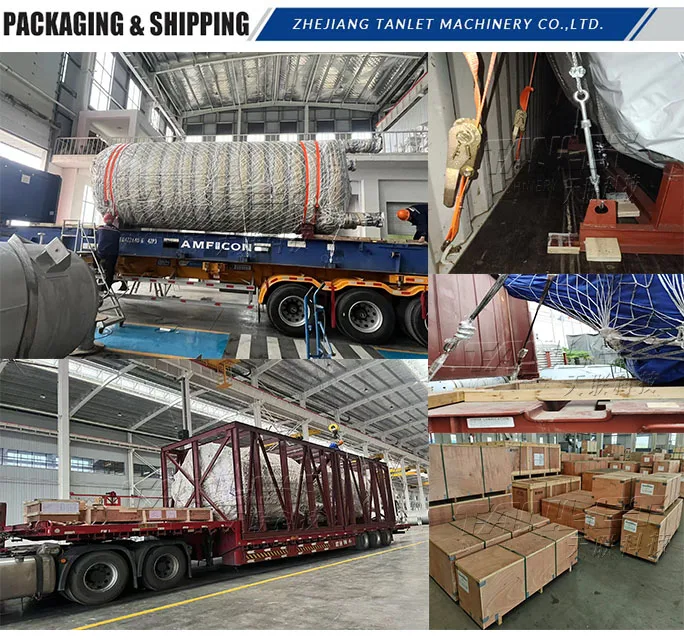
Delivery & Transportation
All delivery terms are available: EXW, FOB, CIF, CFR, DAF, DDP, CIP, etc.
Shipped in 45 days after the deposit confirmed.
Packing
The equipment and accessories will be packed in the wooden case, to ensure safe shipping.
Payment Terms
T/T, L/C, Western Union, Paypal, Apple Pay, Online Payment, etc.
Our Certificates


FAQ
Zhejiang Tanlet Machinery is one of the most professional concentrator/evaporator manufacturers and suppliers in China. With a professional production team, we are able to meet the needs of the majority of our customers. Please rest assured to wholesale high quality concentrator/evaporator from our factory.
Wiped Thin Film Evaporator, Three effect Energy saving Evaporator, Triple Effect Falling Film Evaporator